What Are the Actual Marketplace Fees & How to Calculate Them
Marketplace fees aren't just admin costs. There are program fees, advertising, and payment fees. Learn the fee structure, how to calculate total fees, and simulate their impact on profits with a turnover of Rp 10–50 million.

cshub
29 Jul 2026 8 min read
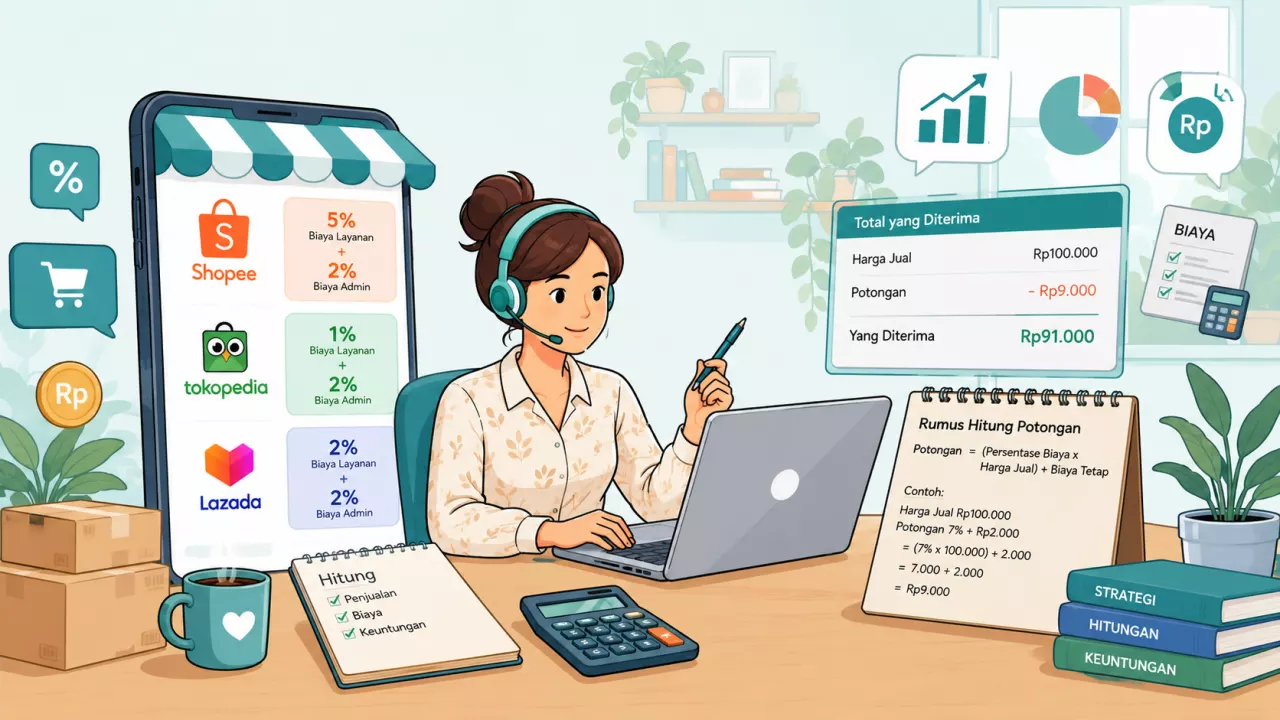
The short answer: the total marketplace fees generally range from 8–12% per transaction — but that figure isn't a single cost. It's a combination of administrative fees, program fees (like free shipping), and other active service fees in your store. Many sellers only realize the admin fee, then are surprised when their net margin is thinner than expected. This article breaks down each cost component and how to calculate your store's total fees.
The exact figures for each component vary by platform, product category, and programs you participate in — and can change at any time. Therefore, the most useful thing for you is not a rate table (which quickly becomes outdated), but how to calculate it — so whenever rates change, you can recalculate yourself in 5 minutes.
What do marketplace fees consist of?
Marketplace fees are a combination of several costs automatically deducted from each transaction before funds are forwarded to the seller. Common components include:
Administrative fees — the basic percentage per transaction charged to all sellers. The amount varies by product category and seller type (regular, star/mall, etc.).
Program fees — additional fees if you participate in platform programs, most commonly free shipping and cashback/promo programs. This often becomes the second-largest component — and the most frequently overlooked.
Additional service/feature fees — some platforms charge for certain services (e.g., fulfillment services, premium store features).
Internal advertising fees — technically not a "fee," because you decide to advertise. But in practice, many stores find it hard to get traffic without internal ads — so include it in your channel cost calculations.
Important note: when a seller says "marketplace fees are only 5%," they usually mean just the basic admin fee. After adding free shipping program fees and other active service fees, the real total fees generally reach around 8–12%. Always calculate the total of all active components in your store, not just one component.
How to calculate your store's total fees (5 minutes)
The formula is simple:
Total fees (%) = admin fees + active program fees + active service fees
Steps:
Open your store's settings/financial reports in your platform's seller center. Look for "fees" or "charges" details per order.
Take the last 5–10 orders, see the difference between the selling price and the funds you actually receive.
Calculate the percentage: (selling price − received funds) ÷ selling price × 100%.
Average it out. That's your store's real fees — the actual figure, not the brochure number.
Steps 2–3 are the most accurate, as they come directly from your store's actual transactions — including all active programs without needing to read rate documents one by one.
Fee overview per platform (as of mid-2026)
As an initial reference, here are the fee ranges in major Indonesian marketplaces. Important note: these figures change over time and vary by product category and store status — use them as a guide, then verify in your platform's Seller Center.
Marketplace | Main fee scheme | Admin fee range | Notes |
|---|---|---|---|
Shopee | Commission per category + store status (Non-Star/Star/Mall) | ± 2.5%–10% (Fashion, FMCG & Lifestyle at the higher end) | New sellers are exempt from processing fees for the first 50 orders |
Tokopedia | Commission per category + dynamic commission | Up to ± 10%; total before ads usually 8–12% | Processing fee Rp 1,250/order |
TikTok Shop | Follows Tokopedia structure (same entity) | ± 1%–10% | Additional TikTok layer: affiliate commission for creators driving sales |
Lazada (Regular) | Commission per category | ± 4.25%–8% | Processing fee Rp 1,250/order |
Lazada (LazMall) | Commission + additional services | ± 7.8%–10.3% | Higher fees with exclusive benefits (branding, search priority) |
Blibli | Category commission & merchant scheme | ± 5%–10% | Processing fees included in commission scheme; focus on official brands & verified sellers |
And one figure you need to be aware of: the above ranges are fees before advertising. If internal platform ads are included — which in many categories are practically mandatory to compete — the total effective cost per sale can reach 15–25% of the selling price. This is why calculating your store's real fees (method above) is far more important than memorizing rate tables.
Simulation: impact of fees on profit at various turnover levels
Assumption: total fees 10% (midpoint of the general range), excluding advertising costs.
Turnover/month | 10% Fees | Fees/year | Equivalent to... |
|---|---|---|---|
Rp 10,000,000 | Rp 1,000,000 | Rp 12,000,000 | ± salary of 1 part-time admin |
Rp 20,000,000 | Rp 2,000,000 | Rp 24,000,000 | ± cost of sales tools for 5+ years* |
Rp 50,000,000 | Rp 5,000,000 | Rp 60,000,000 | ± salary of 2 employees for a year |
* Illustrative comparison using all-in-one tools in the range of Rp 300–500 thousand/month.
Two things are evident from this table:
First, fees are a percentage — they grow with turnover. Tools or your own website costs are generally flat. This means the larger your store, the greater the difference between "paying a percentage" and "paying flat." At a turnover of Rp 10 million, the difference isn't felt; at Rp 50 million, that's an employee's salary.
Second, fees affect turnover, not profit. If your gross margin is 30%, a 10% fee on turnover is equivalent to one-third of your margin. This is why two stores with the same turnover can have very different profits — depending on what percentage of sales go through fee-charging channels.
Are marketplace fees worth it?
The honest answer: often yes — for new buyers. The fees are essentially "traffic rental costs": you're paying for access to millions of people who are already looking to shop, plus a trust system (escrow, ratings) that makes strangers willing to transfer money to your store. For new stores or new products, it's cheap compared to building traffic from scratch.
What makes it expensive is when even repeat buyers continue through fee-charging channels. Customers who already know and trust your store no longer need the marketplace's "trust system" — but if they repeat order through the marketplace, you still pay the same fees as for new buyers.
This is where the strategy used by many experienced sellers comes in: marketplace for acquisition, own channels for repeat orders. The first purchase comes from the marketplace; after that, invite them to continue on WhatsApp or your own online store — where there are no fees and the data is yours. Our complete guide covers this:
How to reduce fee burdens without leaving the marketplace
No need to immediately "exit" the marketplace — the sensible move is to shift the composition:
First, calculate your store's real fees (method above). Without this figure, all decisions are just feelings.
Separate new buyers from repeat buyers. Check what percentage of your monthly orders come from people who have bought before.
Direct repeat orders to your own channels. Insert an invitation to WhatsApp in the package/thank-you card; keep buyer contacts organized; greet them when there's a new product.
Prepare a serious own channel. At a minimum: your own catalog + checkout, one inbox for all chats, and automated follow-ups — so the buying experience on your own channel is as smooth as the marketplace. Platforms like CShub provide this in one dashboard (storefront without per-transaction fees, WhatsApp CRM, and AI that replies to chats and creates invoices), starting at Rp 300,000/month with a 7-day free trial. (Disclosure: this article is written by the CShub team — but steps 1–3 above apply no matter what tools you use.)
Regularly evaluate platform programs. Free shipping programs increase conversion but also increase fees — check if the sales increase still covers the costs for your category.
FAQ — Frequently Asked Questions
What percentage are marketplace fees in Indonesia? Total fees generally range from 8–12% per transaction — a combination of admin fees, program fees (like free shipping), and active service fees. If internal ads are included, effective costs can reach 15–25%. The exact figure varies by platform, category, and seller type, and can change at any time; the most accurate way is to calculate from the difference between the selling price and the funds received in your last 5–10 orders.
Why is the amount I receive smaller than the admin fee calculation? Almost always because there are active program fees — most commonly free shipping programs — plus other service fees. Check the fee details per order in the seller center: all fee components are listed per transaction there.
Is participating in free shipping programs a loss? Not necessarily. Free shipping generally increases conversion, so the question isn't "loss or not" but "does the additional sales cover the additional fees." Test per category: compare sales and profit when the program is active vs. not.
How to sell online without fees? Through your own channels: an online store with its own checkout, or direct closing via WhatsApp. You still pay for tools and payment gateways, but both are much smaller and mostly flat — not growing with turnover.
If I move to my own store, will buyers follow? New buyers are difficult; repeat buyers are much easier — they already trust your store. Therefore, the realistic strategy isn't a total move, but to shift repeat orders to your own channels while the marketplace continues for acquisition.