What is WhatsApp CRM? A Complete Guide for SMEs
WhatsApp CRM is a system that manages chats, leads, and orders from WhatsApp in one organized dashboard. Learn how it works, how it differs from regular WhatsApp Business, and when your business needs it.

cshub
08 Aug 2026 7 min read
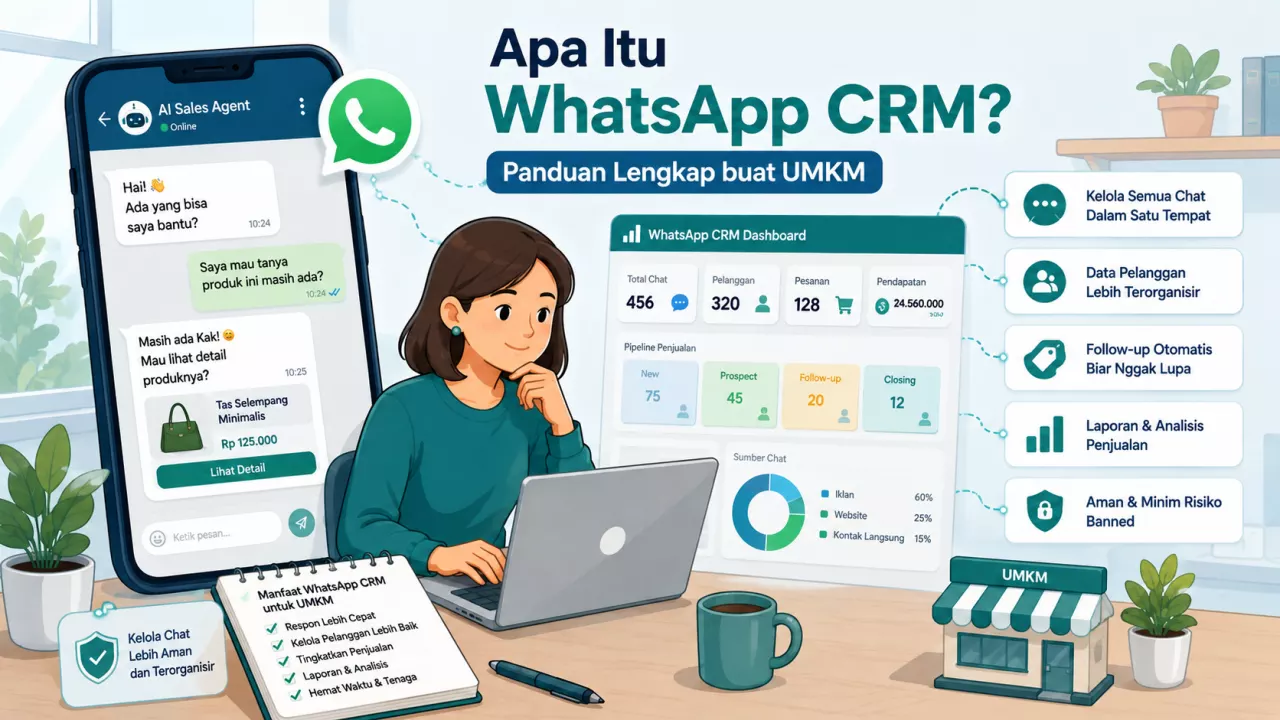
WhatsApp CRM is a system that connects WhatsApp chats with customer data and order status — so every conversation is not just "replied to" but also recorded: who is chatting, what stage they are at (just inquiring, checked out, paid), and their purchase history. Regular WhatsApp Business allows you to reply to chats; WhatsApp CRM lets you know what to do with those chats next.
This guide explains how it works, when regular WhatsApp is sufficient, and when you need to upgrade to CRM, as well as what features should be included.
What is WhatsApp CRM?
CRM stands for Customer Relationship Management — a system for managing relationships with customers. WhatsApp CRM applies this concept specifically to WhatsApp chats: every contact that chats is entered into a system that records who they are, what they are asking, what stage they are at in the buying process, and their previous interaction history.
The difference from regular WhatsApp is not in "can reply to chats or not" — both can. The difference is in what happens after the chat is replied to. In regular WhatsApp, once the chat is scrolled up, the information is almost lost — it's hard to remember who has checked out, who is still waiting for an answer, who is a returning customer. In WhatsApp CRM, all of this is neatly recorded and can be viewed at any time.
Why is regular WhatsApp Business not enough?
WhatsApp Business (regular app) is designed for simple one-to-one communication — and for stores with few chats, it's sufficient. Problems start to arise when chat volume increases:
Chats pile up and get scattered. Dozens of chats come in simultaneously from WA, plus Instagram DMs — the admin loses track of who has been replied to and who hasn't.
No record of lead status. Who just inquired, who has chosen a product but hasn't paid, who is waiting for a response — all are only in the admin's memory, lost when the admin changes shifts or forgets.
Follow-ups rely on memory. Without status records, follow-ups become inconsistent — leads that should be revisited are missed.
Customer history is not neatly stored. Returning customers who want to order again have to be manually searched for their chat history, or even treated like new customers.
Can only be used on one device/admin at a time comfortably. Once there is more than one admin, coordination becomes complicated without a system that divides and records who is handling whom.
This is not the user's fault — WhatsApp Business is not designed to handle that scale. WhatsApp CRM fills that gap.
What features are included in WhatsApp CRM?
Core components that differentiate it from regular WhatsApp:
Centralized inbox (omnichannel). Chats from WhatsApp, Instagram, Messenger, Telegram, and other channels come into one view — no need to switch between apps.
Pipeline/lead status. Each contact is given a status (just inquired → interested → checkout → paid → completed) so it's clear what stage each is at. Usually displayed as a visual board (Kanban) that can be moved between statuses.
Complete history per contact. All previous conversations and orders are stored in one contact profile — so when a returning customer chats again, their history is immediately visible.
Labels & segmentation. Contacts can be grouped (new customers, loyal customers, interested in certain categories) for more targeted follow-ups or broadcasts.
Team collaboration. Multiple admins can handle chats from the same system, with clear division of who holds which contact.
Basic automation. Scheduled follow-ups, automatic replies for common questions, or reminders for unpaid orders.
WhatsApp CRM vs Regular WhatsApp Business: When to Upgrade?
Situation | Regular WhatsApp Business | Time for WhatsApp CRM |
|---|---|---|
Incoming chats per day | Dozens, still manageable | Tens and above, starting to get scattered |
Number of admins | One person | More than one, need coordination |
Leads to follow-up | Remembered manually, still under control | Often forget who needs to be revisited |
Sales channels | Only WhatsApp | WhatsApp + Instagram + other channels simultaneously |
Reporting needs | No need | Want to know how many leads come in vs closing |
There is no exact number when you "must" switch — but the clearest sign is when you start losing leads not because they are not interested, but because they get lost in the midst of piling chats.
What is WhatsApp CRM Official vs Unofficial?
One technical thing to understand before choosing a platform:
WhatsApp Business Platform (Cloud API / "Official") — the official route from Meta, designed for businesses with high chat volume and reliability needs. Can get a verified blue checkmark.
WhatsApp "Unofficial" — connects a regular WhatsApp Business number to a CRM system without going through Meta's official API. More flexible and cheaper to start, but riskier if used for large message volumes.
For SMEs just starting with medium chat volumes, the unofficial route is often a sensible starting point. Once volume and brand trust become priorities, the official route is more secure in the long term. A good platform supports both, so you can start from anywhere according to current needs.
How to choose the right WhatsApp CRM
Several things to check before choosing a platform:
Is the inbox truly omnichannel, or just WhatsApp even though you sell on multiple channels?
Is there AI/automation to answer basic questions, so not every chat has to be answered manually one by one?
Is it connected to the order/payment system, or does it stop at "managing chats" without linking to transactions?
Does it support the official WhatsApp route (Cloud API) for when you need to scale up?
What are the costs and what is included — some platforms charge extra per feature; check the total real cost, not just the base price.
CShub is built to address these five points in one dashboard: omnichannel inbox (WhatsApp Cloud & Unofficial, Instagram, Messenger, Telegram, LiveChat), CRM & Kanban pipeline, AI Sales Agent that can directly create transactions, and transparent pricing starting at Rp 300,000/month with a 7-day free trial. (Disclosure: this article is written by the CShub team — the five points above apply to any WhatsApp CRM platform you consider.)
FAQ — Frequently Asked Questions
What is the difference between WhatsApp CRM and regular WhatsApp Business? Regular WhatsApp Business is an app for replying to chats one by one. WhatsApp CRM adds a management layer: lead status, customer history, team collaboration, and automation — so chats are not only replied to but also recorded and can be systematically followed up.
Do small SMEs need WhatsApp CRM? Not necessarily at the start. If chats are still a dozen per day and one admin can still monitor everything, regular WhatsApp Business is enough. WhatsApp CRM becomes relevant when chat volume starts to get scattered or leads start to be lost because they are not followed up.
What is WhatsApp CRM omnichannel? It means the system combines chats from various channels — WhatsApp, Instagram, Messenger, Telegram, and others — into one inbox, so admins don't need to open multiple separate apps to serve buyers from different channels.
Is WhatsApp CRM safe and official? It depends on the platform and route used. The official route (WhatsApp Business Platform/Cloud API) is the safest way for large volumes. The unofficial route can still be used reasonably for medium volumes, as long as it is not used to send mass messages excessively.
How much does WhatsApp CRM cost for SMEs? It varies depending on features and the number of users. As a reference, all-in-one WhatsApp CRM platforms in the Indonesian market start from around Rp 300,000 per month for the basic package.