Safe Ways to Broadcast on WhatsApp Without Getting Banned
Worried about your store's WhatsApp number getting banned due to broadcasts? Learn the acceptable message limits, the difference between regular WhatsApp Business and Cloud API, and how to broadcast safely without annoying customers.

cshub
04 Aug 2026 7 min read
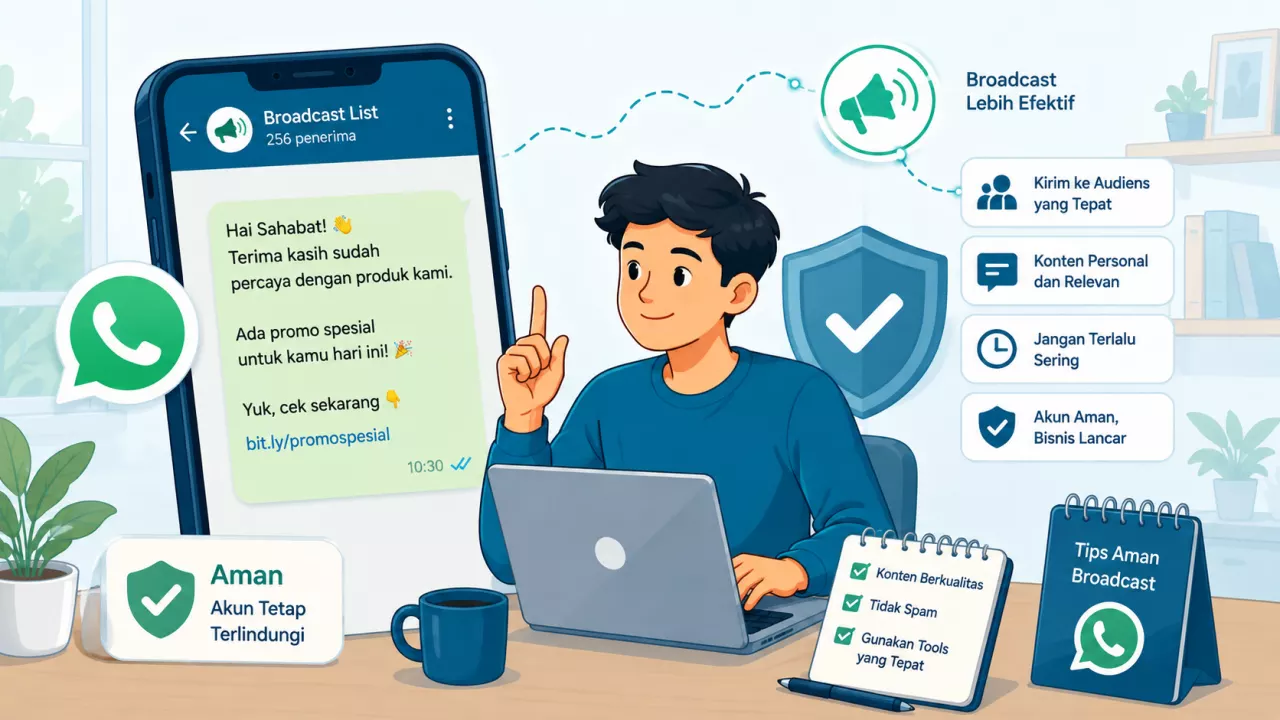
Your WhatsApp number gets banned not because of "broadcasts," but due to patterns detected as spam by WhatsApp's system: sending to many numbers that have never chatted first, identical messages sent en masse in a short time, and a high rate of messages blocked/reported by users. Broadcasting to people who have interacted with your store, with reasonable volume and relevant content, is much safer — and for large scale, the official channel (WhatsApp Business Platform/Cloud API) is specifically designed for this.
This article explains how WhatsApp spam detection works, the safe limits you can adhere to, and how to broadcast effectively without risking your store's number.
Why can a WhatsApp number get banned?
WhatsApp detects suspicious behavior through several signals, not a single rule:
Message ratio to people who have never chatted. Sending to many unfamiliar numbers in a short time is the number one pattern associated with spam.
Rate of blocked/reported messages. If many recipients block or report your number, the system flags it automatically — this is the strongest signal, as it comes directly from users.
Speed & volume of sending. Hundreds of messages in minutes from a personal number appear unnatural compared to human chat patterns.
Repeated identical content. The exact same message sent to many numbers consecutively is a typical bot/spam pattern.
New number with sudden high activity. A newly registered number that immediately broadcasts massively is more prone compared to a number with a normal chat history.
Important block: broadcasting itself is not a violation. What makes it risky is to whom, how many, and how similar the content is. A store sending promotions to 50 old customers who have ordered before, with personalized messages, has a much lower risk compared to sending 500 identical messages to numbers that have never known the store.
Difference between regular WhatsApp Business and WhatsApp Business Platform (Cloud API)
This is the most important distinction that sellers rarely understand:
Aspect | WhatsApp Business (regular app) | WhatsApp Business Platform (Cloud API / "Official") |
|---|---|---|
Usage | App on phone, like personal WhatsApp | Connected through Meta's official system/API |
Mass broadcast | Limited & high risk if volume is large | Designed for messages sent to many contacts, with official rules (message templates, opt-in) |
Verification & trust | Standard | Can get a verified blue check |
Cost | Free | Paid per message category (following Meta's official cost structure that changes over time) |
Suitable for | Small stores, low–medium chat volume | Stores with large chat/broadcast volume & need reliability |
For sellers just starting with chat volumes still in the tens per day, regular WhatsApp Business is generally sufficient — as long as the pattern is reasonable. Once broadcast volume starts reaching hundreds–thousands of contacts routinely, the official channel (Cloud API) is the path designed for that, and the risk is much more controlled compared to forcing large volumes through the regular app.
Safe broadcast limits: practical guide
There is no official number published as a "definite limit" — and that number can change at any time following WhatsApp's policy. But the safe principle to hold:
Send only to those who have interacted. Customers who have chatted, ordered, or explicitly given their number for promotions. Not from scraping or buying databases.
Segment, don't blanket. Broadcast skincare promotions to customers who have bought skincare, not to all contacts regardless of the product. This lowers the block ratio because the content is relevant.
Vary the sentences, don't send 100% identical text to hundreds of numbers consecutively. Minimal personalization (name, last product) already helps.
Space out sending, don't send hundreds of messages in minutes. The more gradual, the more it resembles a normal human chat pattern.
Provide an opt-out option. Phrases like "type STOP if you don't want promo updates anymore" reduce the rate of customers blocking — they have control, so they prefer to unsubscribe rather than report.
Switch to the official channel once the volume is large. If routine broadcasts to hundreds/thousands of contacts have become a core part of your business, it's time to move to the WhatsApp Business Platform (Cloud API) rather than continuing to force it through the regular app.
Common broadcast mistakes that lead to bans
Buying/using external number databases. This is the most severe violation — sending to people who have never known your store has the highest block/report ratio.
Broadcasting to all contacts without segmentation, including old contacts who have forgotten they ever chatted with your store.
Too frequent broadcasts — daily promo broadcasts make customers tired and more likely to block.
Ignoring those who ask to stop. Continuing to send to people who have said "STOP" or blocked before accelerates the decline in number reputation.
New number immediately used for large broadcasts. A number without a normal chat history, suddenly sending hundreds of messages, is the most suspicious pattern in the system's eyes.
Safer alternatives than mass broadcasting
Broadcasting is not the only way to reach old customers. Some lower-risk options:
Targeted personal follow-up — greeting relevant customers one by one (see How to Follow-up Customers on WhatsApp) instead of mass broadcasting to all contacts.
WhatsApp Status — uploading promotions in status viewed by customers who saved your number, without sending direct messages at all.
Small segmented broadcast list — group customers by interest/product category, send to small relevant groups, not one giant list.
Official channel with clear opt-in — for large volumes, use Cloud API with customers who have truly agreed to receive updates (for example, through a form at checkout).
Safe broadcasting methods when using CRM/tools/platform
If you are using a CRM platform for broadcasting (not manually through the regular WhatsApp app), features you need to ensure are present:
Automatic segmentation based on customer labels (previous orders, product categories, etc.) — not sending to all contacts at once
Schedule & sending intervals that can be set, not sending simultaneously in seconds
Support for official channels (WABA/Cloud API) for when your volume is already large
Automatic personalization (inserting names/products into each message without manually typing one by one)
At CShub, broadcasts are designed to be targeted based on customer labels & behavior — not sending blanket messages to all contacts — and support WhatsApp's official channels for stores with large volumes. (Disclosure: this article is written by the CShub team — the above security principles apply with any tools you use, including manually with regular WhatsApp Business.)
FAQ — Frequently Asked Questions
How many broadcast messages are safe to send per day? There is no official number published, and the policy can change — but the safe principle is not about the number, but who the recipients are. Broadcasting to hundreds of relevant old customers is safer than broadcasting to 20 foreign numbers from scraping. Start small, watch for reports/blocks, then gradually increase.
Why is my WhatsApp number temporarily blocked even though I only broadcast promotions? Most likely because the message ratio to recipients who have never chatted is too high, or there are several recipients who reported the message as spam. WhatsApp's system evaluates based on those signals, not the sender's good intentions.
What is WhatsApp Business Platform / Cloud API and what is the difference? This is Meta's official channel for businesses sending large volumes of messages in a structured manner, different from the regular WhatsApp Business app. This channel has its own rules (such as approved message templates) that actually make large volume broadcasts safer and more stable compared to forcing them through the regular app.
Is it safe to broadcast to customers who haven't ordered in a long time? Relatively riskier compared to active customers, because they may have forgotten they ever chatted with your store and are more likely to mark it as spam. If you want to reconnect with old customers, use a personal follow-up approach first, not mass broadcasting.
Is using CRM/tools for broadcasting safer than regular WhatsApp Business? Good tools help enforce safe practices (segmentation, sending intervals, support for official channels) that are difficult to consistently do manually — but tools do not eliminate the risk entirely if used to send to irrelevant contacts in large volumes. The security principles remain the same, tools just make it easier to execute them correctly.