WhatsApp API Replies Cost Money from October 2026: The Math for Small Shops
WhatsApp API pricing changed on October 1, 2026: 1,000 free service messages per number, then you pay. See Rupiah rates and a sample cost for a small shop.

cshub
21 Oct 2026 9 min read
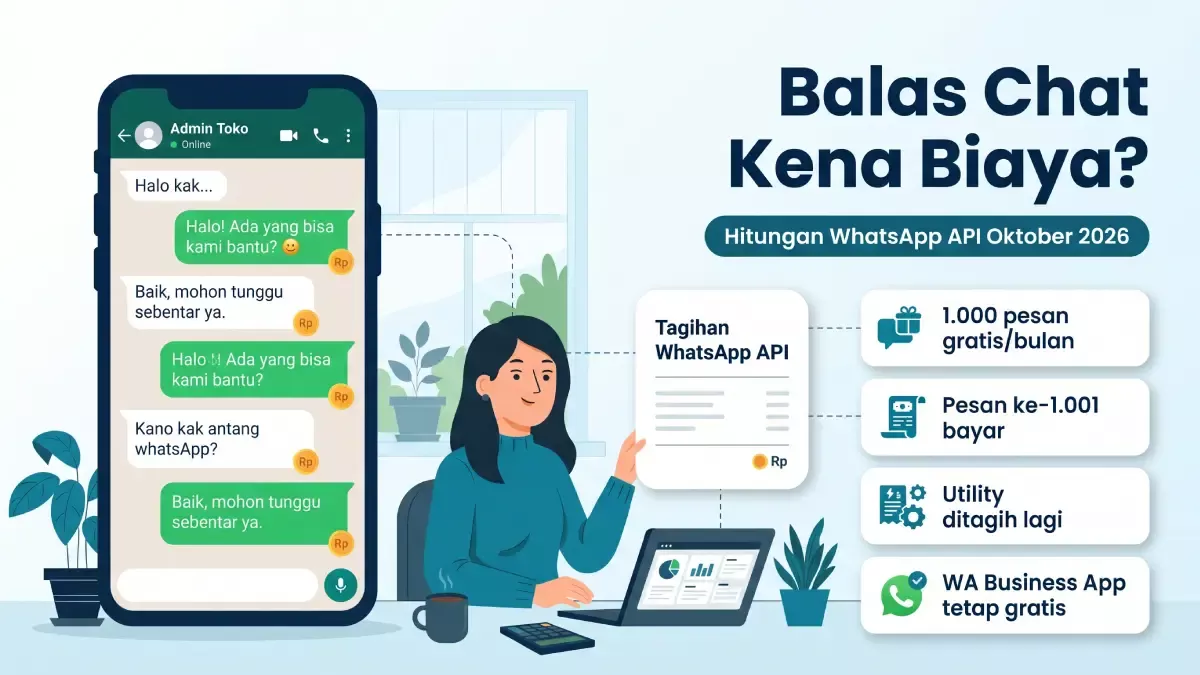
Starting October 1, 2026, WhatsApp API pricing changes: Meta is charging again for replies to customers. Each business number gets 1,000 free service messages per month, and from message 1,001 onward you pay per message. Utility messages (order confirmations, tracking numbers) sent inside the 24-hour window are also charged again. If you use the regular WhatsApp Business app on your phone, this change doesn't affect you, because these rates only apply to the WhatsApp Business Platform (API).
Below are the details, sample Rupiah calculations for a small shop, and how to decide whether your business really needs the API or can stay on the App.
What changed in WhatsApp Business API pricing in October 2026?
The main source is Meta's WhatsApp Business Platform pricing documentation. We last checked it on October 20, 2026. It comes down to four things.
- Service messages are no longer free without limit. A service message is your normal reply to a customer who messaged you first, while the 24-hour window is still open. According to Meta, each business number gets 1,000 free delivered service messages per month. Unused quota doesn't carry over to the next month.
- Utility messages inside the 24-hour window are charged again. These messages had been free since July 1, 2025. From October 2026, utility templates like "Your order has shipped, JNE tracking number 123..." are charged per message even if the customer messaged you five minutes ago.
- Billing is per message, not per conversation. This model has been in place since July 1, 2025. So five reply bubbles count as five messages.
- Chats from Click to WhatsApp ads still get a free window. Meta says marketing, utility, authentication and service messages aren't charged while that free window is open, and the window can last up to 7 days. The condition: the customer comes from an ad and opens the chat in the Android or iOS app.
Meta also changed around 40 rates across various countries on the same date. So the old numbers you saved last year are probably out of date.
How much does the WhatsApp API cost in Indonesia now?
Meta publishes official rate cards in several currencies, including Indonesian Rupiah (IDR). You can download the CSV and PDF files from Meta's pricing page above, and there's an interactive version on the WhatsApp Business pricing page.
The numbers in this table come from the IDR rate card as quoted by API providers (BSPs) such as ChatMaxima and the copy of the IDR rate card published by Gupshup. Treat them as estimates as of October 20, 2026, before Indonesia's 11% VAT (PPN).
| Message category | Example | Estimated rate per message |
|---|---|---|
| Marketing | 11.11 sale promo, new product info | about Rp586 |
| Utility | Order confirmation, tracking number, bill reminder | about Rp357 |
| Authentication | Login OTP code | about Rp357 |
| Service (after the free 1,000) | Normal chat replies to customers | about Rp357 |
Two important notes. First, utility and authentication rates drop in tiers if your monthly volume is large, while marketing has no volume discount. Second, many BSPs add their own service fee on top of Meta's rates. The bill you get may be higher than this table. Ask your provider for the breakdown before you sign.
Sample monthly cost for a small business
Take an online skincare shop in Bekasi. One admin, one WhatsApp API number. The numbers below are an example, not customer data.
- About 40 customers message per day. On average each chat gets 3 reply messages (greeting, price info, total plus shipping). Over a month that's roughly 40 x 3 x 30 = 3,600 service messages.
- 10 orders come in every day. Each order gets 2 utility messages: payment confirmation and tracking number. That's 600 utility messages a month.
- A payday promo broadcast to 500 past customers, once a month. That's 500 marketing messages.
| Item | Billable amount | Estimated cost |
|---|---|---|
| Service: 3,600 minus 1,000 free | 2,600 messages x Rp357 | Rp928,200 |
| Utility | 600 messages x Rp357 | Rp214,200 |
| Marketing | 500 messages x Rp586 | Rp293,000 |
| Subtotal | Rp1,435,400 | |
| VAT (PPN) 11% | Rp157,894 | |
| Estimated total | about Rp1.59 million per month |
Before October 2026, the first two rows were almost entirely free. The same shop only paid for its broadcast, roughly Rp325 thousand after VAT. The difference is about Rp1.2 million per month, and it comes from everyday chat replies, not from promos.
Now compare that with a coffee stall that takes orders by chat, 10 customers a day, 2 replies per chat. That's 600 service messages a month in total. Still under 1,000, so the replies stay free. At volumes this small, the October change barely makes a difference.
A quick way to estimate your own cost
- Count incoming chats per day, multiply by the average number of reply bubbles, then multiply by 30.
- Subtract 1,000. If the result is negative, your service cost is zero.
- Multiply what's left by the service rate in the latest IDR rate card.
- Add utility messages (confirmations, tracking numbers, bills) and marketing messages (broadcasts).
- Add 11% VAT and any BSP service fee.
How to cut the bill without replying more slowly
Because billing is per message, scattered replies get expensive. An admin who types "Hi there", then "One moment please", then "It's Rp89,000", then "Shipping to Depok is Rp12,000" uses up four messages. The same answer fits in one message.
Hi Rina, the 20 ml vitamin C serum is Rp89,000. Shipping to Depok via JNE REG is about Rp12,000, so the total comes to Rp101,000. Shall I go ahead and create the order for you?
A few other habits that help:
- Combine the payment confirmation and delivery estimate into one utility message, not two.
- Use complete quick replies (price, shipping, how to pay) so admins don't patch answers together one message at a time.
- If you run Click to WhatsApp ads, focus on closing the sale while the free window is still open.
- Choose your broadcast recipients. 200 customers who bought in the last 3 months are usually more useful than 2,000 numbers that went quiet long ago.
WhatsApp Business App vs API: what's the difference?
The WhatsApp Business App is the free app you install on your phone. You can use it on several linked devices, and it has a catalog, labels and quick replies. There's no per-message billing, and the October 2026 price change doesn't apply to the App.
The WhatsApp Business Platform (API) is the official route for software systems. The number isn't opened from a regular phone app but through software connected to Meta. You pay per message according to the rate card, plus a provider fee if there is one.
| Topic | WhatsApp Business App | WhatsApp Business API |
|---|---|---|
| Message cost | Free | Pay per message (1,000 free service messages per number per month) |
| Official message templates | None | Yes, require Meta approval |
| Broadcast to many contacts | Limited, risk of being blocked if overdone | Through official marketing templates |
| Integration with other systems | Limited | Full, through the API |
| Best for | Low to medium volume, 1-2 admins | High volume, many admins, regular broadcasts |
When does a small business need the API, and when is the App enough?
The WhatsApp Business App is enough if:
- Incoming chats are still under roughly 50 a day and 1-2 people can handle them.
- You only broadcast now and then to customers who actually saved your number.
- You don't need official templates for order confirmations or OTPs yet.
- The owner still often replies personally from their phone.
Start considering the API if:
- You regularly broadcast to hundreds or thousands of contacts and worry about your number getting blocked.
- You need automatic notifications that reliably arrive, such as tracking numbers or installment bills.
- You run a lot of Click to WhatsApp ads, because the free window only applies on the API.
- You want to connect WhatsApp to other systems, such as an online store or point of sale, through the official route.
Many small businesses end up in the middle: the main number stays on the App for everyday chat replies, and a second number uses the API just for notifications and broadcasts. With this split, thousands of chat replies never show up on a per-message bill.
How cshub helps with both options
The cshub inbox can connect regular WhatsApp by scanning a QR code as well as the official WhatsApp Business API (WABA), plus Instagram DM, Facebook Messenger, Telegram and website live chat. So you can start with an App number, then add an API number once your volume actually calls for it, without switching apps.
It includes quick replies and message templates, so a price plus shipping answer can go out in one complete message. Broadcasts and follow-ups can be sent to contact groups you choose. The AI agent answers from your knowledge base, can check stock and shipping costs, then create orders straight from the chat.
Meta's per-message fees for API numbers are still paid separately according to the rate card. cshub's own plans start with a free Trial, then Starter at Rp300,000 per month. Details are on the pricing page.
FAQ
Will the WhatsApp Business App on my phone start costing money in October 2026?
No. The October 1, 2026 price change only applies to the WhatsApp Business Platform (API). The WhatsApp Business app on your phone stays free to use.
Is the 1,000 free message quota per account or per number?
Per business number, per month. According to Meta's documentation, what counts is delivered service messages. Unused quota expires and doesn't carry over to the next month.
If a customer messages from an ad, do I pay for the replies?
While the free window from a Click to WhatsApp ad is still open, Meta doesn't charge for marketing, utility, authentication or service messages. The condition is that the customer opens the chat from the Android or iOS app, not WhatsApp Web or desktop.
Why do Rupiah rates differ from website to website?
Some sites list Meta's base rates, some have already added the BSP service fee, and some still use an old rate card. The safest reference is still the latest IDR rate card on Meta's pricing page.
Do the rates in this article include VAT?
No. The per-message rates in the table are estimates before Indonesia's 11% VAT (PPN). The monthly example above already adds VAT, but doesn't include API provider fees.