Leads Come In, Responded Once, Then Disappear — This is a System Issue, Not a Personnel Problem
Many SMEs lose leads not because their products are bad, but because there's no system ensuring every lead is followed up. Here's how a visual sales pipeline can boost your closing rate.

cshub
10 Jun 2026 7 min read
Leads come in, responded once, then disappear
Ads are running. Chats come in. You respond.
The potential buyer says "later, I'm still thinking about it." You say "okay, if you have any questions, contact us again." And you close the chat.
Three days later, that potential buyer purchases from the shop next door.
Not because your product is bad. Not because your price is high. But because the shop next door followed up first — sent a small message on the second day: "Are you still interested in the product? Stock is running low." And that's what closed the deal.
You didn't have time because you forgot. Or because there was no reminder. Or because you didn't even know that lead was still "stuck" and not yet closed.
This is not about your sales team not trying hard enough
Before blaming anyone, look at the system.
Most SMEs still manage leads this way: WhatsApp chats come in, responded manually, if it closes, great, if not, that's it. There's no record of who has been given a price, who is still waiting, who needs to be followed up tomorrow.
The result? Lead data is scattered everywhere — in different salespeople's personal WhatsApp, in phone notes, in spreadsheets with different formats for each person. When someone in your team forgets or resigns, that data disappears with them.
Research shows 80% of deals require at least 5 follow-ups before closing. But most salespeople stop after 1-2 times. Not because they're lazy — but because there's no system reminding them who to follow up with, when, and what to say.
What's really happening behind the scenes
Try a rough calculation. Suppose your business gets 50 leads per month from ads and organic. Ad cost is Rp 1 million. If the closing rate is only 10%, that means 45 leads are lost just like that.
Of those 45 lost leads, how many could actually be closed with consistent follow-up? Let's say 20%. That's 9 additional deals — which never happened not because they didn't want to buy, but because you didn't have time to get back to them.
The money has been spent on ads. The leads have come in. The only thing missing is the system.
What is a sales pipeline, and why you need it
A sales pipeline is not expensive software only used by big companies. It's a simple concept: visualizing the journey of each lead from first contact to closed deal.
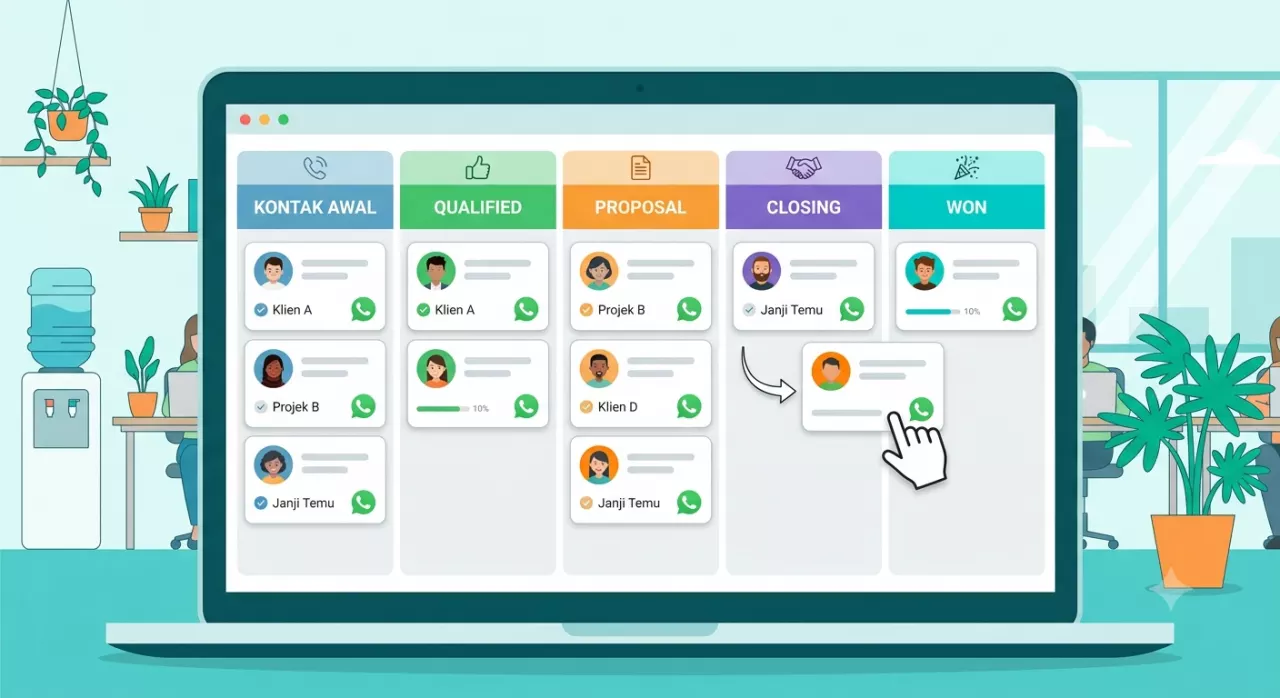
The simplest form is a kanban board — a board with columns that you can drag according to progress. Each lead has its own card, and each card can be moved to the next column as its status advances.
Why visuals are important
Imagine two scenarios:
Scenario A: You have 30 leads this month. All are on WhatsApp. You don't know who has been given a price, who is still asking for info, who is almost closing.
Scenario B: You open one dashboard. Instantly visible — 12 leads in "Initial Contact," 8 in "Qualified," 5 in "Proposal," 3 in "Closing," 2 already "Won." You know exactly what to do today.
Scenario B is not only neater — it allows you to work with a calm mind, not constantly reacting.
Common pipeline columns used by SMEs
Initial Contact — new leads come in, not yet qualified Qualified — needs, budget, and serious intent to buy are known Proposal — price/offer given, waiting for decision Closing — one step away, final follow-up Won — deal successfully closed Lost — didn't happen, can be labeled with reasons for data
What you can do with a proper pipeline
Know exactly which leads to chase today
Open the board in the morning, and immediately know: leads in the "Proposal" column that have been silent for 3 days — those are the ones to touch first. No need to scroll through hundreds of chats for context.
Forecast revenue without guessing
If there are 5 leads in the "Closing" column with an average deal value of Rp 500k, the potential revenue this week is Rp 2.5 million. This is not an estimate — it's a calculation from real data in front of you.
Identify where leads often get stuck
If every month many leads come in but always "die" at the "Proposal" stage, there's a problem there — maybe the price offer is not convincing enough, maybe the follow-up is too slow, maybe stronger social proof is needed. The pipeline gives you data to improve the process, not just chase leads.
Onboarding new sales becomes easier
New sales join? They can immediately see all existing leads, conversation history, and what to do next. No long briefing needed, no leads falling through the cracks during team transitions.
Bonus: if you already have a sales team
The pipeline is not just for solo founders. If you already have 2-3 people handling sales, the pipeline ensures all leads are covered — not piling up on one person, not competing, not missing anyone.
You as the owner can see from above: how many total leads this month, who is closing the most, and where the bottleneck most often occurs. This is insight you can't get if everything is still on individual WhatsApp.
Start simple, tomorrow
You don't need complex and expensive enterprise CRM to start a pipeline.
At cshub, the Leads Kanban feature is already integrated directly with the chat inbox. Every WhatsApp conversation can be turned into a lead with one click. Leads appear on the board, can be dragged, can be noted, can be set for follow-up reminders.
Setup in 10 minutes. No coding needed. No long training required.
Every lead that comes in tomorrow can immediately enter the pipeline — and you know exactly what to do with them.
Frequently asked questions
Is a sales pipeline the same as a CRM? A sales pipeline is part of a CRM. CRM is broader — covering all data and interactions with customers. A sales pipeline specifically visualizes the progress of each lead from start to closing.
Is a pipeline suitable for small SMEs that are still solo? It's actually most needed. If you handle everything yourself, a pipeline is how you ensure no leads are missed amid other busy tasks. Even with 10 active leads, a pipeline makes a real difference.
How many columns are ideal for an SME pipeline? 4-6 columns are sufficient. Too many columns can be confusing. The important thing is that each column has a clear definition — what it means for leads to be there and what should be done next.
What if leads say "still thinking"? Don't close the chat — move it to the "Nurturing" column or label it, and set a follow-up reminder 3-5 days later. "Still thinking" is not a rejection, it's a signal they need more time and information.
In cshub, can leads from other channels (Instagram, Telegram) enter the pipeline too? Yes. All conversations from all channels that enter the cshub inbox can be directly converted into leads in the kanban. One pipeline for all channels.
If leads don't close, is the data lost? No. Leads that enter the "Lost" column remain stored with complete conversation history. This data is very useful for analysis — why they didn't buy, and what can be improved.
Related articles