Selling on Marketplaces vs. Your Own Online Store: The Honest Breakdown
Marketplace or your own online store? Which is more profitable for SMEs? Analyze costs, fees, customer data ownership, and combined strategies. Honest calculations without the drama.

cshub
28 Jul 2026 7 min read
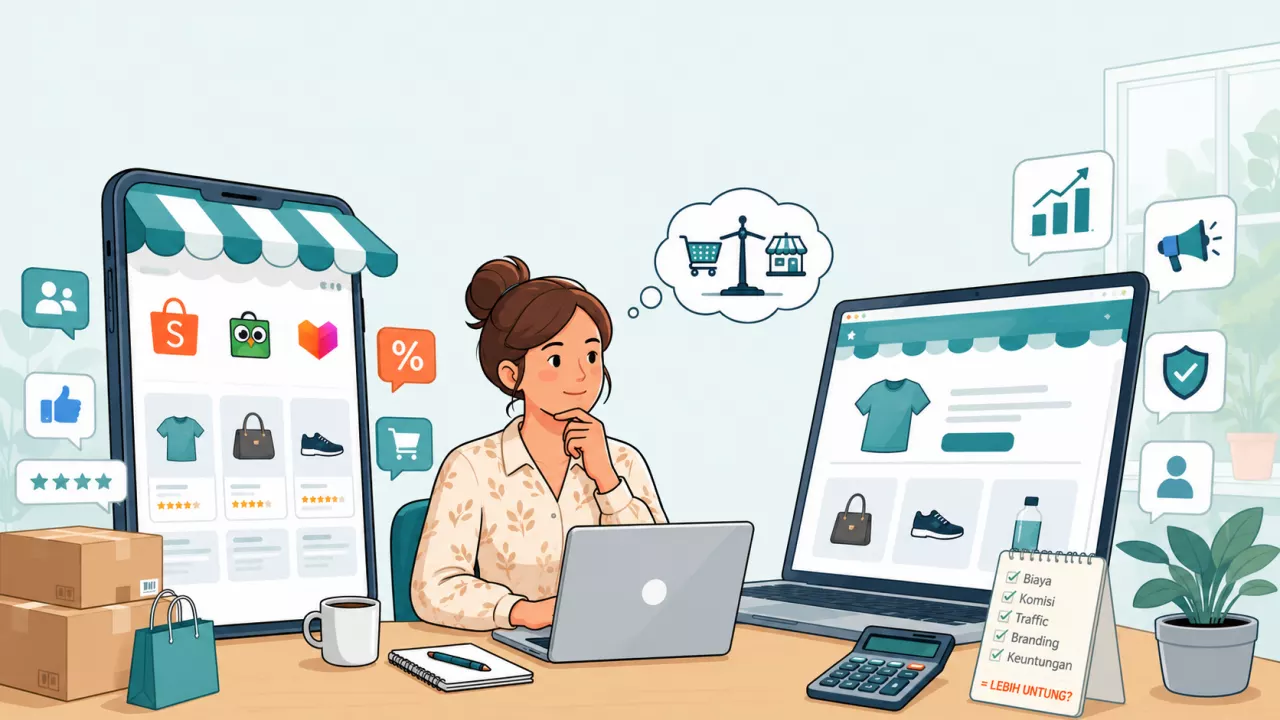
The short answer: marketplaces excel at attracting new buyers due to their high traffic, but each transaction incurs a fee of around 8–12%, and customer data remains with the platform. Your own online store has no transaction fees, and you own the customer data, but you must generate your own traffic. The most sensible strategy for most SMEs: use both — marketplaces for acquisition, your own store for repeat orders.
This article breaks down the numbers so you can make decisions based on data, not assumptions.
What's the difference between selling on a marketplace and your own online store?
Selling on a marketplace means setting up shop on someone else's platform (like Shopee, Tokopedia): traffic, payment systems, and shipping are provided, but you follow platform rules and pay per transaction fees. Your own online store means having your own website/storefront with your own checkout: no per transaction fees, and all buyer data is in your hands.
The main difference isn't just about costs — it's about who owns the customer relationship.
What are the actual costs of selling on a marketplace?
The main cost of selling on a marketplace is the administrative fee per transaction, typically ranging from 8–12% depending on the platform, product category, and programs you join (like free shipping or priority services). Beyond that, many sellers also spend on internal platform ads to make their products appear in searches.
The exact figures change over time and vary by category — always check the official fee page of the marketplace you use. But for rough calculations, 8–12% is a realistic range to use as a reference.
Simple simulation: revenue of Rp 20 million/month
Component | Selling on Marketplace | Your Own Online Store |
|---|---|---|
Monthly Revenue | Rp 20,000,000 | Rp 20,000,000 |
Platform fee (assumed 10%) | – Rp 2,000,000 | Rp 0 |
Tools/platform store cost* | Rp 0 | – Rp 300,000 |
Payment gateway fee** | included | – (per transaction, generally ~1–2%) |
Net income (before ads) | ± Rp 18,000,000 | ± Rp 19,300,000 |
Example: CShub Starter package Rp 300,000/month includes storefront + checkout. Other tools have different prices. * Payment gateway fees vary by provider and payment method — check with your provider.
The difference is about Rp 1–1.5 million per month on Rp 20 million revenue — and the larger the revenue, the bigger the difference, because marketplace fees are percentage-based while tool costs tend to be flat.
But wait — this isn't the full story. The above simulation assumes the revenue is the same in both places. In reality, marketplaces bring traffic that you don't automatically have in your own store. That's where the real trade-off lies.
Pros and cons of each (honestly)
Marketplace
Pros:
High buyer traffic — people come specifically to shop
Instant trust: escrow system makes new buyers confident to transact
Shipping, payment, and logistics are integrated
Great for quickly validating new products
Cons:
Transaction fees (± 8–12%) that grow with revenue
Customer data belongs to the platform — you can't directly follow up with buyers outside the platform
Intense price competition; buyers compare your product with dozens of others
Platform rules can change anytime, including fees and search algorithms
Your Own Online Store
Pros:
No transaction fees — full margin
100% ownership of customer data: WhatsApp numbers, purchase history, preferences — key for repeat orders
Freedom in branding, promotions, upselling/bundling
Direct relationship with customers through chat — no intermediaries
Cons:
You must generate your own traffic (content, ads, or community)
Need to build trust — new buyers are more cautious about transferring to unknown stores
Requires tools to manage orders, chat, and payments (though many are now no-code)
Why is customer data so important?
Because acquiring new buyers is far more expensive than selling to existing ones — in marketing practice, acquiring new customers is generally estimated to be about 5 times more costly than retaining existing ones.
In a marketplace, buyers who have purchased from you still "belong" to the platform: you don't have their contact, can't reach out when you have new products, and when they want to buy again, they go through the marketplace search — where your competitors wait with lower prices.
In your own store, every buyer leaves a WhatsApp number. This means you can:
Automatically follow up for repeat orders
Broadcast promotions to the right segments (not just random blasts)
Revive carts abandoned before payment
A buyer in your own store is more valuable than one in a marketplace — not because the transaction is bigger, but because you can bring them back.
So which to choose: marketplace or your own store?
The honest answer: for most SMEs, it's not about choosing one — but both, with different roles.
Your situation | Recommendation |
|---|---|
Just starting, product not yet validated | Start on a marketplace — use its traffic to test the market |
Already have regular buyers / repeat orders | Build your own store — move repeat orders to a fee-free channel |
Marketplace revenue already in the tens of millions | Prioritize your own store — 8–12% fees on large revenue are significant |
Selling through chat (WA/IG) is already busy | Your own store + CRM — you already have traffic, just streamline the system |
The most successful pattern: marketplace as the entry point, your own store as the home. New buyers come from the marketplace; after the first transaction, direct them to your own channel (WhatsApp, your own store) for future purchases — so repeat orders no longer incur fees and you maintain the relationship.
How to start your own online store without hassle
In the past, having your own online store meant hiring developers and spending millions. Not anymore. What you need:
Storefront + checkout — a store page with an integrated product catalog and payment (payment gateway), no coding required
One inbox for all chats — so questions from WA, IG, and other channels don't get lost
Follow-up system — automatically re-engage leads who haven't purchased and abandoned carts
Organized customer data — contacts, history, and labels stored in one place
Platforms like CShub combine all of this into one dashboard — storefront + checkout with no per transaction fees, WhatsApp CRM, and an AI Sales Agent that can reply to chats, follow up, and even create automatic transactions. Starting at Rp 300,000/month, with a 7-day free trial and no credit card required. (Disclosure: this article is written by the CShub team — but the calculations above apply regardless of the tools you use.)
FAQ — Frequently Asked Questions
Is selling on marketplaces still worth it in 2026? Yes, especially for acquiring new buyers and product validation. What's changed is the strategy: smart sellers use marketplaces as an acquisition channel, then move repeat orders to their own fee-free channels.
What are the marketplace fees in Indonesia? Generally around 8–12% per transaction, depending on the platform, product category, and programs joined (like free shipping programs). The exact figures change over time — always check the official fee page of the platform you use.
Do you need coding skills to create your own online store? No. Modern online store platforms provide storefronts, product catalogs, and checkout with payment gateways that are easy to set up — including landing pages and forms without coding.
How do you get buyers for your own store? The three most common sources: (1) marketplace buyers directed to your channel after the first transaction, (2) organic content on IG/TikTok leading to your store link, (3) ads directed straight to WhatsApp or checkout — not to marketplace listings where competitors are also displayed.
What are the risks of relying too much on marketplaces? Unilateral policy changes: fees can increase, search algorithms can change, and accounts can face restrictions. Since buyer data isn't yours, when this happens, you start from scratch. Your own store is an asset; a marketplace listing is a rental.