How to Follow Up with Customers on WhatsApp Without Seeming Pushy (+ Sample Phrases)
Leads keep asking questions and then disappear? Learn how to follow up with customers on WhatsApp politely yet effectively: perfect timing, 10+ ready-to-use sample phrases, and mistakes that drive buyers away.

cshub
03 Aug 2026 7 min read
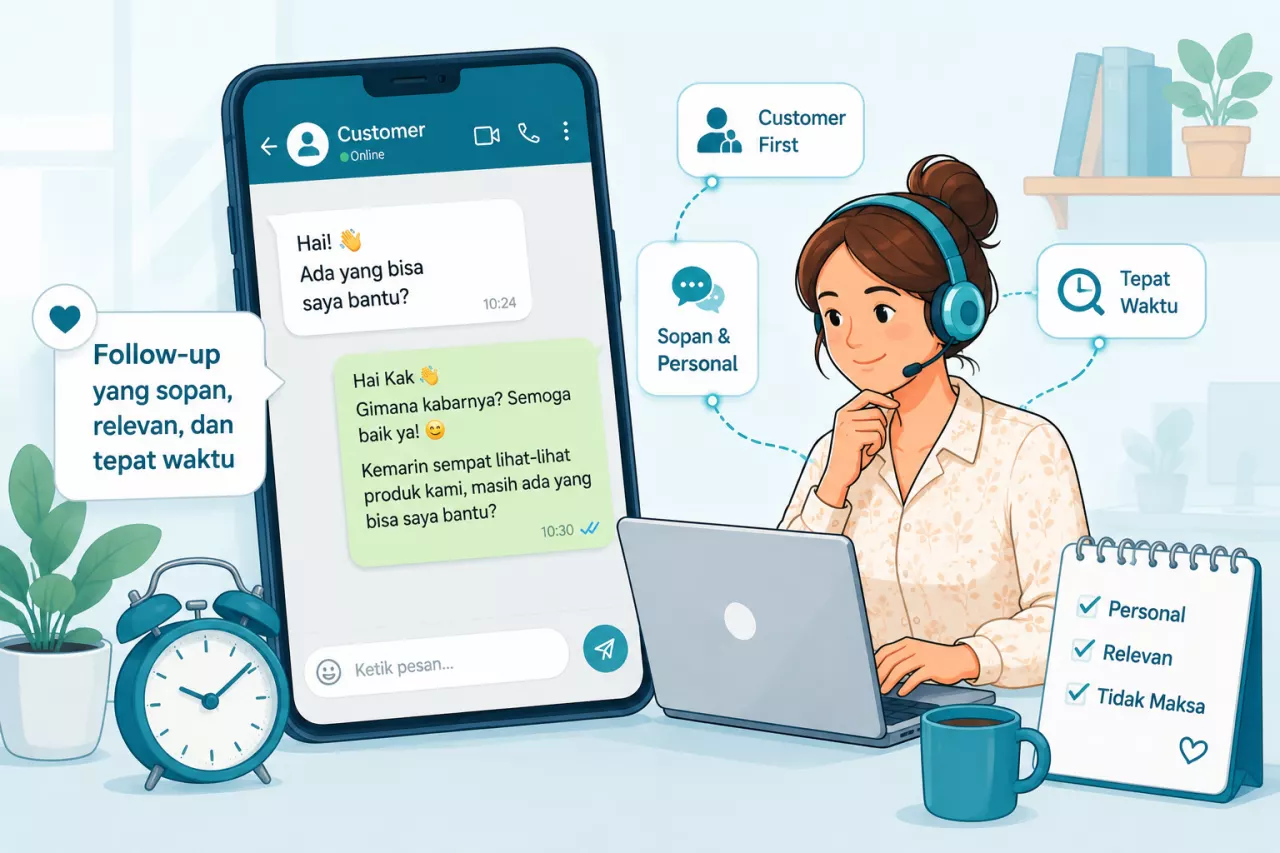
A follow-up that doesn't feel pushy has three characteristics: it adds value (not just asking "are you going to order?"), it's timely (within the first 24–48 hours for new leads), and it's easy to respond to (specific questions, not just "how's it going?"). Most sales actually happen after the 2nd or 3rd follow-up — not the first chat — so not following up is like leaving revenue on the table.
In this article: when is the right time to follow up, ready-to-use sample phrases for various situations, and mistakes to avoid.
Why is follow-up important (and why do many sellers skip it)?
Most buyers don't purchase on the first chat. They ask questions, compare with other stores, then get distracted — not rejecting, just not yet. Without follow-up, "not yet" automatically turns into "not buying," because more proactive stores will engage them.
Sellers often skip follow-ups not out of laziness, but because they're afraid of seeming pushy, don't have time (new chats keep coming in), and lack records of who needs to be contacted again. All three can be addressed — the first two with methods discussed in this article, the third with a system.
When is the right time to follow up?
A practical rule you can use immediately:
Situation | 1st Follow-up | 2nd Follow-up | Stop after |
|---|---|---|---|
New leads ask questions then disappear | 24 hours | 2–3 days later | 3× without response |
Selected product but hasn't paid (cart/invoice pending) | 1–3 hours | 24 hours | 2–3× |
Said "later / need to discuss first" | According to the time they mentioned (+1 day) | 3–4 days | 2× |
Old customers who haven't ordered in a while | 2–4 weeks since last order | next month | — (switch to periodic greetings) |
Two principles behind this table:
The warmer the lead, the quicker the follow-up. Someone who has selected a product but hasn't paid is the warmest — reach out within hours, not days.
There is a limit. After 2–3 times without a response, stop. A 5th follow-up won't change "not interested" to "buy" — it only turns your store into "the one that spams."
Sample follow-up phrases for each situation (ready to use)
The principle of all the examples below: short, specific, providing a reason to reply — and none of them sound like "are you going to order?"
Situation 1 — Leads ask questions then disappear
"Hi [name] 😊 you asked about [product] yesterday. Coincidentally, the color you were interested in is running low — would you like me to reserve it for you?"
"Hi, you were browsing [product] yesterday. If you're still undecided between [variant A] and [variant B], in short: [1 sentence main difference]. Hope this helps you decide 🙏"
Why it works: both provide new information (stock, comparison) — not demanding a decision.
Situation 2 — Ready to order but hasn't paid
"Hi [name], your order is ready, just waiting for payment 😊 The payment link is active until [time]. If there's any issue with the payment process, just let me know — I'm here to help."
"Hey, I'm holding the invoice until tonight. If you want to change the variant/quantity before paying, you still can 🙏"
Why it works: emphasizes the order is "real" + opens the door if there are obstacles (often people haven't paid because they're unsure how, not because they've changed their mind).
Situation 3 — "Later / need to discuss first"
"Hi [name] 😊 you mentioned needing to discuss first — while waiting, I'll send you real photos of the product from previous buyers to help visualize it better."
"Hi, as promised, I'm following up today 😄 Any more questions about [product] that I can help answer?"
Why it works: the first adds more consideration; the second keeps a promise — both feel helpful, not pressuring.
Situation 4 — Reviving old customers
"Hi [name]! Is your [previously purchased product] still holding up well? 😄 This week we just got [complementary/restock/new variant product] — letting our loyal customers know first before posting publicly."
Why it works: "letting you know first" makes old customers feel special — and they should, as they're your store's most valuable asset.
Situation 5 — Last follow-up (closing the loop politely)
"Hi, this is my last follow-up about [product], after this I won't bother you again 😄 If you need anything later, just chat anytime — happy to help 🙏"
Why it works: letting them know it's the last often prompts a response ("oh yes, sorry, I'm interested") — and even if not, your store leaves a polite impression, not spam.
5 follow-up mistakes that drive buyers away
"Are you going to order?" — demanding a decision without offering anything. Replace with new information/value in every message.
Following up every day. High intensity = pressure, not attention. Follow the intervals in the table above.
Rigid copy-pasting that looks mass-produced. At least mention their name and the product they asked about — these two small details turn "broadcast" into "attention."
Sending at odd hours. Early morning or late night feels intrusive. Safe: 9 AM–8 PM.
Not stopping after being rejected. "Not interested" should be answered with "thank you for stopping by 🙏" — and that's it. A door closed politely can reopen; one that's repeatedly knocked on will be locked.
How to ensure follow-up is consistent (without relying on memory)
The biggest issue with follow-up isn't the phrasing — it's consistency. When dozens of chats come in daily, it's impossible to remember who needs to be contacted again tomorrow, who promised "after payday," and whose invoice is pending. The solution is a system, not memory:
Record the status of each lead — at a minimum: just inquiring / selected product / hasn't paid / has paid. This is a basic CRM function.
Set reminders or automation — follow-ups for unpaid carts and disappearing leads can be sent automatically based on the timing pattern you set (such as the timing pattern in the table above), complete with their name & product.
Separate what can be automated from what requires a human touch. Payment reminders and initial greetings are safe to automate; negotiations and complaints should go to an admin.
At CShub, this process is unified: leads are recorded in the pipeline, follow-ups are automatically sent based on labels & behavior (including recovering unpaid carts), and the AI Sales Agent responds to incoming questions anytime — while cases needing a human touch are handed over to you. (Disclosure: this article is written by the CShub team — all the techniques above can still be practiced manually without any tools; tools just make it consistent.)
FAQ — Frequently Asked Questions
How many times should you follow up with a potential buyer? Generally 2–3 times with increasing intervals (24 hours → 2–3 days), then stop if there's no response. Most closings happen on the 2nd or 3rd follow-up; beyond that, additional messages are more likely to damage your image than increase sales.
When is the best time to send a follow-up on WhatsApp? During normal active hours (around 9 AM–8 PM). For very warm leads — those who have selected a product but haven't paid — the first follow-up should ideally be within 1–3 hours while their buying intent is still fresh.
How do you follow up with someone who says "not now"? Respect their timing: follow up according to the time they mentioned, and bring something new (real photos, testimonials, stock info) — not just a reminder. If there's no response after two attempts, close politely.
Can follow-up be automated without seeming robotic? Yes, with two conditions: the automated message is personalized (mentioning their name & the product they inquired about) and the timing is human-like — not a barrage of daily messages. Good automation mimics the habits of a polite admin, not a spam machine.
Is it safe to follow up via WhatsApp for the store's number? It's safe as long as the pattern is reasonable: responding to and following up with people who have previously chatted is normal. Risks arise from mass blasts to unknown numbers — that's broadcast territory, and the rules are different (limit volume & use official channels if possible).